Behavioral Leadership Approach and Its Impact Peer Review
Leadership
Behavioral Approaches to Leadership
- What are the behavioral perspectives on leadership?
The most 4 decades of research that focused on identifying the personal traits associated with the emergence of leaders and leader effectiveness resulted in 2 observations. First, leader traits are important—people who are endowed with the "right stuff" (drive, cocky-conviction, honesty, and integrity) are more likely to emerge as leaders and to exist effective leaders than individuals who do non possess these characteristics. 2d, traits are only a part of the story. Traits merely account for office of why someone becomes a leader and why they are (or are not) constructive leaders.
All the same under the influence of the bully homo theory of leadership, researchers continued to focus on the leader in an endeavour to empathize leadership—who emerges and what constitutes constructive leadership. Researchers so began to reason that maybe the remainder of the story could be understood by looking at what it is that leaders do. Thus, nosotros now turn our attention to leader behaviors and the behavioral approaches to leadership.
It is now common to think of constructive leadership in terms of what leaders do. CEOs and direction consultants hold that effective leaders brandish trust in their employees, develop a vision, go along their cool, encourage risk, bring expertise into the piece of work setting, invite dissent, and focus everyone'south attention on that which is important.
Thousand. Labich, 1988, 58–66.
William Arruda, in a Fortune article, noted that "organizations with strong coaching cultures report their revenue to be to a higher place average, compared to their peer group." 60-v percent of employees "from stiff coaching cultures rated themselves as highly engaged," compared to thirteen per centum of employees worldwide."
C. Williams. 2017 (June 23). Leadership: Coaching has a Office to Play in Business. Central Penn Business Journal. http://world wide web.cpbj.com/commodity/20170623/CPBJ01/170629935/leadership-coaching-has-function-to-play-in-concern
Jonathan Anthony calls himself an intrapreneur and corporate disorganizer, considering same-erstwhile, same-sometime comms practices are dying in front of our optics.
J. Anthony. 2017. This Much Nosotros Know. (Accessed August 4, 2017). https://thismuchweknow.net/2016/09/21/10-ideas-and-concepts-that-describe-me-really-well/
Apple founder Steve Jobs believed that the best leaders are coaches and squad cheerleaders. Like views have been frequently echoed by direction consultant Tom Peters.
During the late 1940s, two major enquiry programs—The Ohio State University and the University of Michigan leadership studies—were launched to explore leadership from a behavioral perspective.
The Ohio State Academy Studies
A group of Ohio Country University researchers, nether the direction of Ralph Stogdill, began an extensive and systematic series of studies to identify leader behaviors associated with effective group performance. Their results identified two major sets of leader behaviors: consideration and initiating structure.
Consideration is the "relationship-oriented" behavior of a leader. It is instrumental in creating and maintaining good relationships (that is, addressing the group's maintenance needs) with organizational members. Consideration behaviors include being supportive and friendly, representing people's interests, communicating openly with group members, recognizing them, respecting their ideas, and sharing business for their feelings.
Initiating structure involves "task-oriented" leader behaviors. It is instrumental in the efficient use of resources to reach organizational goals, thereby addressing the group's chore needs. Initiating structure behaviors include scheduling work, deciding what is to exist done (and how and when to do it), providing direction to organizational members, planning, analogous, trouble-solving, maintaining standards of functioning, and encouraging the use of uniform procedures.
Later on consideration and initiating construction behaviors were first identified, many leaders believed that they had to behave one way or the other. If they initiated structure, they could non be considerate, and vice versa. It did not accept long, however, to recognize that leaders tin simultaneously brandish any combination of both behaviors.
The Ohio Country studies are important because they identified two critical categories of beliefs that distinguish one leader from some other. Both consideration and initiating structure beliefs can significantly impact work attitudes and behaviors. Unfortunately, the effects of consideration and initiating construction are not consequent from situation to situation.
E.A. Fleishman. 1953. The clarification of supervisory behavior. Personnel Psychology 37:ane–6; E.A. Fleishman & E.F. Harris. 1962. Patterns of leadership beliefs related to employee grievances and turnover. Personnel Psychology 15:43–56; A. W. Halpin & B. J. Winer. 1957. A factorial study of the leader behavior descriptions. In R.Thousand. Stogdill & A.C. Coons (eds.), Leader behavior: Its clarification and measurement. Columbus: Agency of Business Research, Ohio State Academy; J.K. Hemphill & A.E. Coons. 1975. Development of the leader behavior clarification questionnaire. In R. Chiliad. Stogdill & A. E. Coons (eds.), Leader behavior; S. Kerr & C. Schriesheim. 1974. Consideration, initiating structure, and organizational criteria—an update of Korman's 1966 review. Personnel Psychology 27:555–568.
In some of the organizations studied, for case, high levels of initiating structure increased performance. In other organizations, the amount of initiating structure seemed to make little deviation. Although most organizational members reported greater satisfaction when leaders acted objectively, consideration behavior appeared to have no clear consequence on performance.
Initially, these mixed findings were disappointing to researchers and managers alike. Information technology had been hoped that a contour of the most effective leader behaviors could be identified then that leaders could be trained in the all-time ways to carry. Research made clear, still, that at that place is no i best style of leader behavior for all situations.
The University of Michigan Studies
At about the same time that the Ohio Land studies were underway, researchers at the University of Michigan also began to investigate leader behaviors. As at Ohio State, the Michigan researchers attempted to identify behavioral elements that differentiated effective from ineffective leaders.
D. Katz & R.L. Kahn. 1952. Some recent findings in human relations research. In E. Swanson, T. Newcomb, & East. Hartley (eds.), Readings in social psychology, New York: Holt, Rinehart, & Winston; D. Katz, North. Macoby, & N. Morse. 1950. Productivity, supervision, and morale in an role situation, Ann Arbor, MI: Plant for Social Research; F.C. Mann & J. Dent. 1954. The supervisor: Member of ii organizational families. Harvard Business organization Review 32:103–112.
The two types of leader behavior that stand out in these studies are task centered and organizational member centered. Job-centered behaviors are devoted to supervisory functions, such as planning, scheduling, coordinating work activities, and providing the resource needed for job performance. Employee-member-centered behaviors include consideration and support for organizational members. These dimensions of behavior, of grade, correspond closely to the dimensions of initiating structure and consideration identified at Ohio Land. The similarity of the findings from two independent groups of researchers added to their credibility. As the Ohio State researchers had done, the Michigan researchers also institute that any combination of the ii behaviors was possible.
The studies at Michigan are significant considering they reinforce the importance of leader behavior. They as well provide the ground for later theories that identify specific, effective matches of work situations and leader behaviors. Subsequent research at Michigan and elsewhere has found boosted behaviors associated with effective leadership: back up, work facilitation, goal emphasis, and interaction facilitation.
D. Yard. Bowers & S. C. Seashore. 1966. Pretesting organizational effectiveness with a four-factor theory of leadership. Administrative Science Quarterly 11:238–262; Yukl, 1971; D.A. Nadler, Yard.D. Jenkins, Jr., C. Cammonn, and E.East. Lawler, Iii. 1975. The Michigan organizational assessment package progress written report. Ann Arbor: Institute for Social Research, Academy of Michigan.
These four behaviors are important to the successful functioning of the group in that back up and interaction facilitation contribute to the group's maintenance needs, and goal accent and work facilitation contribute to the group'south task needs. The Michigan researchers besides found that these iv behaviors do not need to be brought to the group past the leader. In essence, the leader'south real job is to set the tone and create the climate that ensure these disquisitional behaviors are present.
Bowers & Seashore, 1966.
The Leadership Grid®
Much of the credit for disseminating knowledge nearly important leader behaviors must go to Robert R. Blake and Jane S. Mouton, who developed a method for classifying styles of leadership uniform with many of the ideas from the Ohio State and Michigan studies.
R.R. Blake & J.S. Mouton. 1964. The managerial grid. Houston: Gulf; R.R. Blake & J.S. Mouton. 1981. The versatile managing director: A filigree contour, Homewood, IL: Dow Jones-Irwin; R.R. Blake & J.S. Mouton. 1984. The new managerial grid 3. Houston: Gulf.
In their nomenclature scheme, concern for results (product) emphasizes output, price effectiveness, and (in for-profit organizations) a concern for profits. Concern for people involves promoting working relationships and paying attention to issues of importance to grouping members. As shown in (Figure), the Leadership Grid® demonstrates that any combination of these 2 leader concerns is possible, and five styles of leadership are highlighted hither.
Blake and Mouton'south Managerial Grid®
Source: Adapted from R. McKee and B. Carlson. 1999. The Power to Change, p.16.
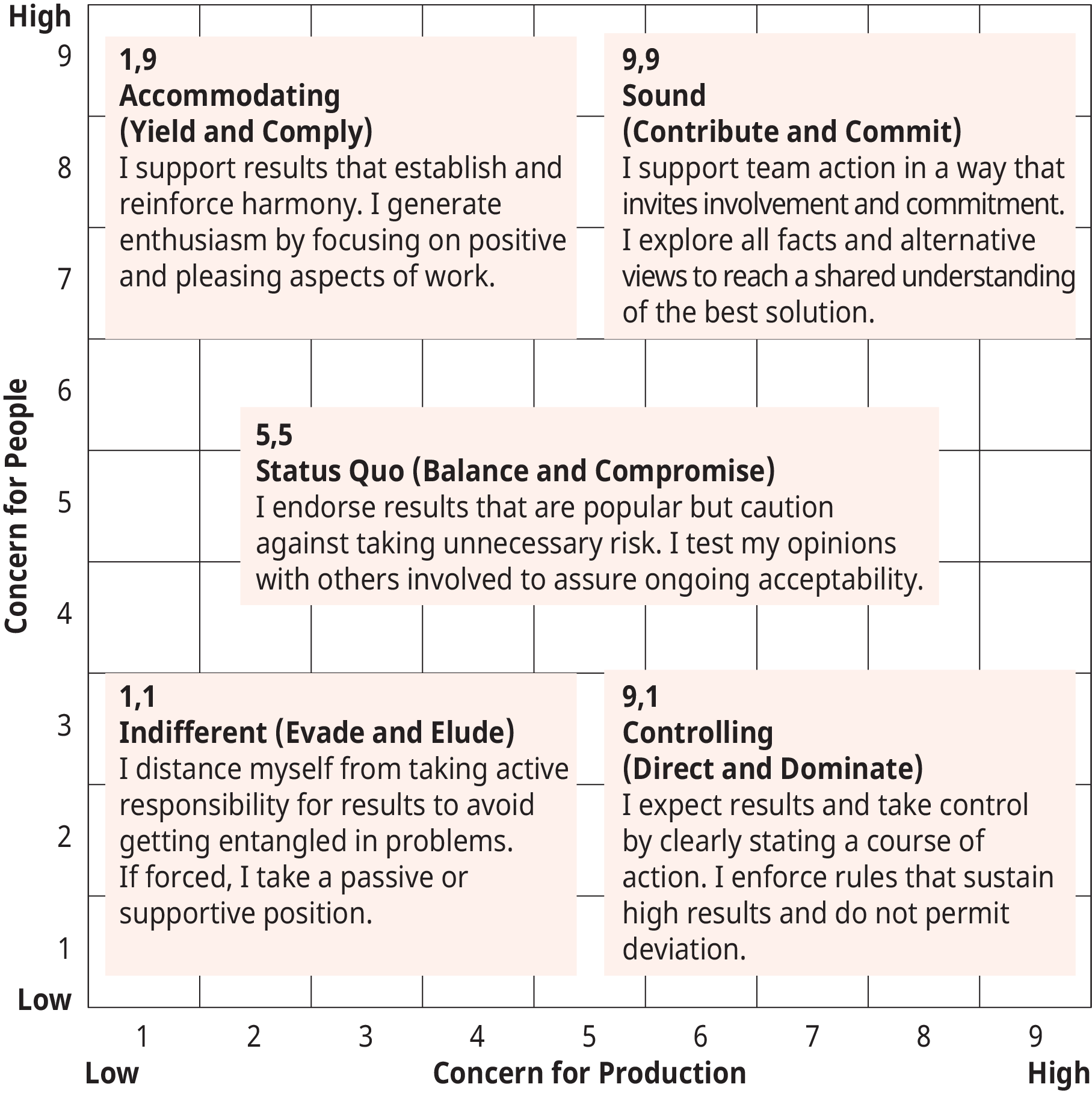
Blake and Mouton contend that the sound (contribute and commit) leader (a loftier concern for results and people, or 9,nine) manner is universally the almost effective.
R.R. Blake & J.Southward. Mouton. 1981. Management past filigree® principles or situationalism: Which? Group and Organization Studies half dozen:439–455.
While the Leadership Grid® is appealing and well structured, inquiry to engagement suggests that in that location is no universally effective style of leadership (9,9 or otherwise).
50. L. Larson, J. Grand. Hunt, & R. N. Osborn. 1976. The dandy hi-how-do-you-do leader beliefs myth: A lesson from Occam'due south razor. University of Direction Journal xix:628–641.
There are, nonetheless, well-identified situations in which a 9,9 manner is unlikely to be effective. Organizational members of high-involvement organizations who take mastered their job duties require piddling production-oriented leader beliefs. Likewise, at that place is petty fourth dimension for people-oriented beliefs during an emergency. Finally, prove suggests that the "loftier-high" way may exist constructive when the situation calls for loftier levels of initiating structure. Under these conditions, the initiation of structure is more acceptable, favorably affecting follower satisfaction and performance, when the leader is as well experienced equally warm, supportive, and considerate.
D. Tjosvold. 1984. Effects of warmth and directiveness on subordinate performance on a subsequent task. Journal of Practical Psychology 69:422–427; A.W. Halpin. 1957. The leader behavior and effectiveness of aircraft commanders. In R.M. Stogdill & A. Eastward. Coons (eds.). Leader Beliefs: Its clarification and measurement. Columbus, OH: The Ohio State University, Bureau of Business Research.; E.A. Fleishman & J. Simmons. 1970. Relationship betwixt leadership patterns and effectiveness ratings among Israeli foremen. Personnel Psychology 23:169–172.
- What are the behavioral approaches to defining leadership?
- What roles practise gender and the popular perceptions of gender roles have on views of leadership traits?
- What are the behavioral perspectives on leadership?
It is articulate that effective leaders are endowed with the "right stuff," notwithstanding this "stuff" is only a precondition to effective leadership. Leaders need to connect with their followers and bring the correct configuration of knowledge, skills, ability, vision, and strategy to the situational demands confronting the grouping.
Glossary
- consideration
- A "relationship-oriented" leader behavior that is supportive, friendly, and focused on personal needs and interpersonal relationships.
- initiating construction
- A "task-oriented" leader behavior that is focused on goal attainment, organizing and scheduling work, solving problems, and maintaining work processes.
Source: https://opentextbc.ca/principlesofmanagementopenstax/chapter/behavioral-approaches-to-leadership/
0 Response to "Behavioral Leadership Approach and Its Impact Peer Review"
Enviar um comentário